Diesel Injector Coding
Modern common rail diesel systems run injectors at pressures above 2,000 bar, with injection events that last just microseconds. At that scale, even a few microliters of deviation per stroke is enough to throw combustion balance off across all cylinders. That is why injector coding is not simply a calibration step. It is the technical foundation that holds the entire system together.
Diesel Injector Coding: The Engineering Foundation of Modern Diesel Performance
Modern common rail diesel systems run injectors at pressures above 2,000 bar, with injection events that last just microseconds. At that scale, even a few microliters of deviation per stroke is enough to throw combustion balance off across all cylinders. That is why injector coding is not simply a calibration step. It is the technical foundation that holds the entire system together.
What Injector Coding Actually Is
No two diesel injectors behave identically. Even from the same production batch, manufactured on the same line with the same tooling, each unit has its own physical fingerprint. Nozzle geometry, needle lift, solenoid or piezo response time, hydraulic flow rate across the operating range. These differences are real, they are measurable, and they matter.
Injector coding is how the ECU learns to work with each individual injector instead of against it. The code carries the injector’s behavioral profile: how fast it opens, how much fuel it delivers at a given pulse width, how its characteristics shift with pressure and temperature. Once that code is written into the ECU, the engine can compensate for per-injector variation and deliver balanced combustion across all cylinders.
Without it, the ECU treats every injector as if it were identical. In practice, that means uneven fueling, rough idle, increased smoke, higher consumption, and long-term stress on injectors, pistons and turbocharger components. In high-pressure common rail engines, generic calibration is not a workaround. It is a source of damage that accumulates quietly over time.
Four Manufacturers, Four Completely Different Systems
This is where a lot of workshops run into trouble. Injector coding is not a standardized process. Each major manufacturer developed its own coding architecture, and the differences between them are not cosmetic. They reflect genuinely different engineering approaches to the same problem.
Bosch works with IMA and IQA codes, typically six-character alphanumeric strings that encode flow deviation data measured at the factory. The ECU uses these to apply per-cylinder trim corrections that bring actual delivery in line with the commanded value.
Delphi uses C2I and C3I protocols. The C3I system encodes a considerably richer dataset, capturing dynamic flow behavior across multiple operating points rather than a single reference condition. Generating a valid C3I code after repair is more demanding than most technicians expect when they first encounter it.
Denso uses QR-based coding, where the matrix encodes flow rate data, serial information, and production parameters together. A misread or incorrectly generated Denso code can produce calibration errors that are genuinely difficult to trace back to their source because the engine runs, just not correctly.
Siemens, particularly on piezo applications, uses IIC coding. Piezo actuators respond to voltage rather than current, and their response curves are tied closely to the physical characteristics of the individual piezo stack inside the injector. Their coding tolerances are the tightest of any common rail technology in regular service.
A tool built around Bosch IQA coding will not produce valid Delphi C3I codes. That is not a gap you can patch with a software update. The underlying data structures are different.
Target Code Generation: The Part Most People Underestimate
Factory injector codes are generated once, before the injector leaves the production line, based on flow measurements taken on the manufacturer’s own bench. The moment that injector is overhauled and its internal components are changed, that original code no longer reflects reality. The injector behaves differently now. The code needs to reflect that.
Target code generation is how you bridge that gap. You measure the reconditioned injector on a calibrated test bench, analyze its actual post-repair behavior, and generate a new code that accurately describes how it performs now. That new code then goes into the ECU, and the engine sees a properly calibrated injector rather than one being controlled by data that no longer applies to it.
This is the step that separates a genuine diesel injection workshop from one that simply swaps parts. Getting it right requires more than test bench access. It requires algorithms that can correctly interpret bench output and translate it into a format the target ECU will accept and use properly.
At Dayel Diesel, three separate target generation systems are built into the Codeman platform. Having multiple systems is not redundancy for its own sake. Different algorithms handle edge cases differently, and being able to cross-validate results gives technicians a level of confidence in the output that a single-system approach cannot provide.
How Codeman Approaches This as a Complete System
The Codeman series was built on the observation that fragmented tooling produces fragmented results. When a workshop uses different software for each manufacturer, each with its own interface, its own update cycle, its own operational logic, the margin for error compounds at every transition point between systems.
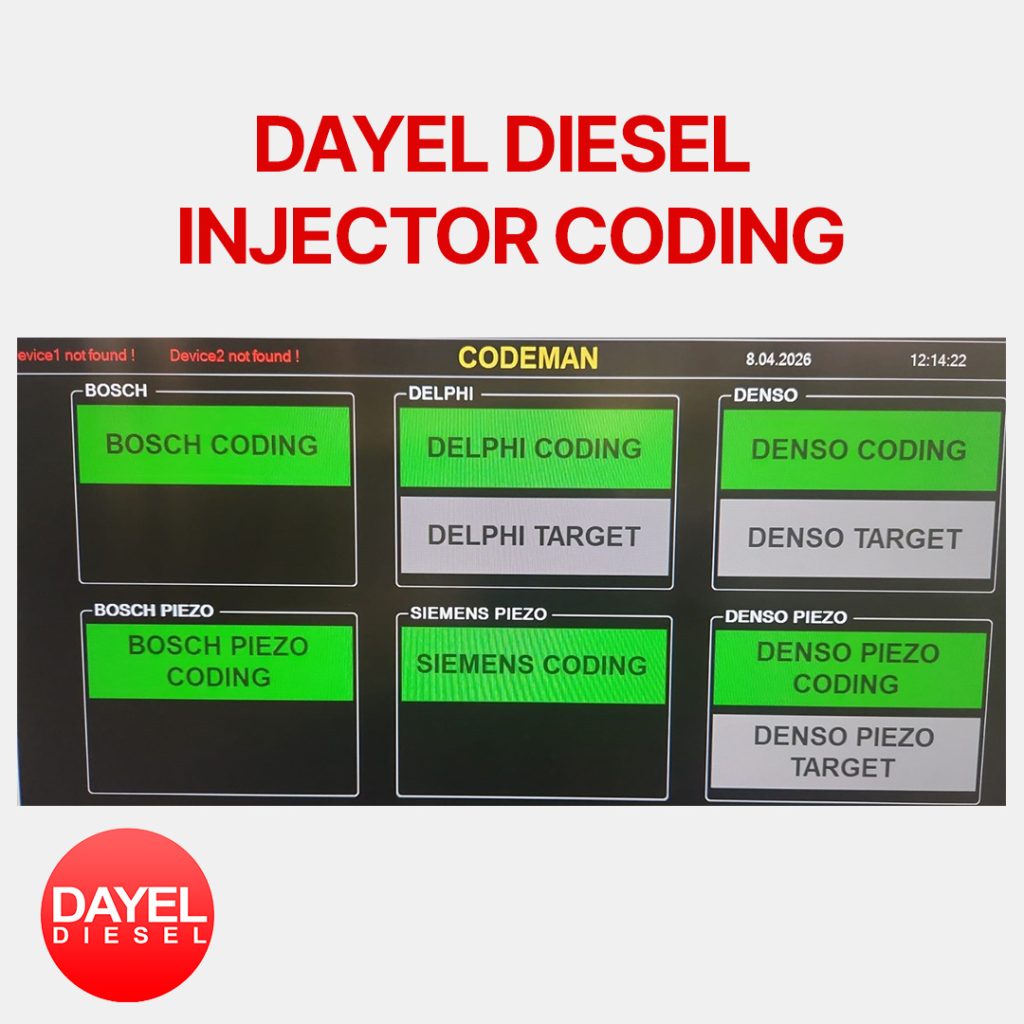
Codeman covers Bosch, Delphi, Denso, and Siemens coding within a single integrated platform, with six dedicated coding programs and three target generation systems operating together in the same environment.
Six coding programs rather than one universal algorithm exist because the physics of different injector types genuinely require different approaches. A solenoid injector with a two-spring hydraulic system and a piezo injector operating at 150 volt actuation voltage are not variations on the same problem. They are different problems that happen to involve fuel delivery. Applying the same coding approach to both produces inferior results with at least one of them.
The six programs allow brand-specific optimization without forcing technicians to leave the platform and switch tools between jobs.
What a System-Level Approach Changes in Practice
Diesel injection service has been fragmented for most of its history, and that fragmentation has real costs. Inconsistent results between jobs, diagnostic errors that stem from calibration rather than hardware, time lost moving between tools and workflows.
When coding, target generation, and multi-brand compatibility are built into a single platform with validated, manufacturer-specific programs, the practical effect shows up in a few specific places: calibration accuracy improves, diagnostic errors decrease, and throughput in the workshop increases because technicians are not managing complexity that the system should be managing for them.
This is the design logic behind Codeman. Injector coding is the point where mechanical reconditioning connects to electronic control. If that connection is made accurately, the engine performs as intended. If it is not, the mechanical work that preceded it does not matter as much as it should.
Getting that connection right consistently, across all four major manufacturers, across solenoid and piezo technologies, after both new installation and post-repair reconditioning, is what the Codeman system was built to do.